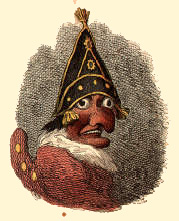
Gaspar und Gretchen

Gaspar

A new form of entertainment has reached Altdorf; a hand puppet or marionette theatre featuring the characters of Gaspar and his wife Gretchen as well as a menagerie of supporting figures. I believe that it traces its origins back to Tilea, although the name Gaspar surely originates from Kislev. For sure, the characters are as colourful as any Tilean and they dress and behave just as outrageously. My theory is that the show reached Kislev before Altdorf, and that is why the main character is called Gaspar. There some who claim that the puppets and the story they play out is a creation of Chaos, a lure to gain access to the minds of the children … and if what I have observed at the secret screenings is true, the adults as well. For each and every person who attends this Gaspar und Gretchen puppet show is enthralled by the spectacle. Given a theory of involvement by the powers of Chaos, the show might have migrated from the Chaos Wastes to Kislev and then further into the Empire and down to Tilea.


The theatre is performed by a “Professor” sitting in a box or a booth equipped with a small stage. He uses puppets or marionettes and the play itself is a string of short episodes each depicting an interaction between two of the characters of the cast. Most often it is the rascal Gaspar together with one of his numerous victims that grace the stage. Gaspar is a symbol of The Great Jester of Old World folklore, and accordingly dresses as a jester in a colourful suit with bells on his hat. He has an enormous hooked nose that curves so as to almost meet his chin. It is almost a beak more than a nose. The puppet is armed with a stick as large as he himself is tall, and he finds great pleasure in using this to rain violence on the other characters of the play. His voice is a squawk, a distinctive and grating noise. This effect is achieved by the Professor using a contraption of weed and wood in his mouth while speaking.

Gaspar und Gretchen

The story varies somewhat between Professors, but the recurring theme is the same; Gaspar behaving totally irresponsible, fighting his wife Gretchen and dealing with their baby in the most outrageous ways imaginable. The cast also consists of a goblin, a hangman, a City Watchman and a powerful Chaos demon named Gideon. Another constant is Gaspar’s punchline “That’s the way to do it”! Gaspar triumphs in a series of encounters with the law but also with the forces of Chaos. The Goblin is a humorous aside, but the final scene is a showdown between Gaspar and Gideon, where the jester ultimately triumphs, exclaiming “Huzzah! Huzzah! I’ve killed the Demon”! Everything is shockingly humorous and performed with great comedic impact, intended to provoke laughter and shocked amusement.

Gaspar und Gideon

So is this Chaos trying to win another foothold in our beleaguered capital? If so it can only be Tzeentch, the Changer of Ways, who advocates such anarchy and wanton behaviour as that displayed by the puppets. And who is The Great Jester if not Tzeentch himself? But then again at the end of the play Gaspar defeats Gideon, a powerful Chaos Demon so maybe this is a show about how to defeat Chaos with Chaos. An intriguing tale for sure. I have no doubt that the Witch Hunters will try to put a stop to the puppet shows by burning every booth and Professor they find. They wait only for our Emperor to sign the suggested law banning these spectacles from performing in the Empire. But given the preponderance of nobles and artistocrats at the shows I have attended, I’m sure that Gaspar is safe for now. I’m not so sure that we are.

Adolphus Altdorfer
Nachexen 25, 2522

Of course, Gaspar und Gretchen is based on the adventures of Punch and Judy. The illustrations are by caracturist George Cruickshank and appeared in The Tragical Comedy or Comical Tragedy of Punch and Judy in 1828.

The possibilities for adventures involving Gaspar und Gretchen are endless. Is the show a conspiracy? Or is it harmless entertainment? Does it hide something sinister and forbidding, or is it a warning to The Empire about the coming of Chaos? And who are the Professors and where do they come from? And last but not least, what if the characters would encounter Gaspar und Gretchen in real life? The horror! The horror!

Magnus

Help wanted (5)

“Greta, I have to see you again. My bethroted suspects foul play. Contact me at The Priest’s Rest so that we can finish our business before the wedding.”

– Note pinned to a door of a disreputable tavern in the Reikhoch Bezirk.

Not all help wanted signs are posted because someone is looking for help from the characters. You can use notes and posters to give your players clues into what is going on in the capital and to foreshadow coming events. Notes like the one above can also raise a lot of questions that makes the players think and to pay attention to what’s happening around them. Is someone planning a wedding? Can they find out who’s getting married? Can they profit from the information gleaned from the note?

Magnus

Horror is not a monster

Today I woke to the distant cries of terrified men and women. The killer the news sheets have named Heartless Jochen has struck again. Now his morbid collection of human hearts number six; three men and three women have fallen to his blade. All have been killed in the Friedwang Bezirk, and all within the month of Nachexen of this year of Chaos. Why does he crave the hearts of other men and women? What is he doing with his trophies? And who is he, this cold blooded murderer? A mutant? A follower of Kaine? Or the Blood God? I hope and pray that the City Watch will find this man … before someone else loses his heart to Heartless Jochen.

Adolphus Altdorfer
Nachexen 18, 2522 IC

On the BI forums, Whymme asked for input for a horror adventure he is putting together. You can read the thread here. There are many great ideas in the thread, so it’s well worth a read. Basically the question was; what could possess someone to commit six gruesome murders, and harvest the victims’ hearts in order to perform a ritual of some kind? I posted to the thread, but then decided to post my answer here as well, and expand somewhat on it.

Lets look at little bit at the horror element. One of my favourite roleplaying games is Call of Cthulhu. The structure of the game as well as the rules seems to be a perfect fit for my style of writing adventures and my style of game mastering. I’m probably a better game master for Cthulhu than for WFRP. So I try to carry much of that style over into my WFRP campaigns, which means an extensive use of common and ordinary NPCs with trivial and even petty motivations.

It is when these motivations lead to actions that are disproportional to the severity of any events experienced by the NPC that a potential for close and personal horror is created. For example, if an NPC’s motive is to get drunk, and he is refused a tankard of beer at his local pub because he looks like he’s already had enough, and this in turn leads to him kidnapping and torturing the pub owner and his family, that is inexplicable horror in its purest essence.

It can’t be easily explained and it can’t simply be blamed on Chaos, demons or monsters that come from the sewers. Sure, there are monsters in WFRP and in Call of Cthulhu, horrible and evil monsters … but we already know that they do horrible and evil things. So the horror of their actions is less effective at creating a sense of dread than similar actions committed by a perfectly normal person, for trivial reasons.

So for the hypothetical situation mentioned in the beginning, I’d base the motive behind the murders and the harvesting of the hearts on an unfortunate sequence of trivialities. The motive is revenge, and this craving for revenge comes from a number of slights against the murderers pride and honour. Most of the offenses are imagined but some are real, and have been going on for many years. Finally, the imagined humiliation has become too much, and now only bloody revenge will wipe the slate clean.

For this, our villain needs the hearts of seven people; three men and three women who has affronted him and one innocent child to close the deal, and all under a dying moon. So all killings must occur under the span of a waxing and waning moon. If the last killing is done under specific circumstances, the ritual will be fulfilled and a plague of demons will descend on the town. Under one night the murderer will be given free command of the horde to wreak his revenge … and then he will be given to the lord of slaughter. The killer is aware of the price he has to pay, and will gladly lay down his life for bloody revenge.

So what could have offended a person enough to hatch a scheme like this?

Just about anything trivial. Getting short changed at the market, buying a pig that turned ill and died the next day, being refused a tankard of beer at the local tavern, even just getting an odd look or a taunt from a child, or a request for a romantic meeting declined … there are thousands of trivial things that might be eternally important for a person like our murderer. And which might be enough to push him over the edge.

For the plot like this to work I think it would have to be set in a fairly large city, like Altdorf, Middenheim or Nuln. The reason for this is that there should be a logical possibility for the murderer to aquire texts on demon summonings from a university, bookshop or a library without getting too much exposure. At the same time this will serve as a path of clues for the characters to find the villain as well as a logical explanation as to where his knowledge of the occult came from. Of course, you can always use demonic influence to explain his new found knowledge, but I prefer his actions to be an active choice, rather than an outside corrupting influence. This makes the crimes more horrible, in my mind.

As I mentioned earlier I think that having lots of NPCs for the characters to interact with is important. For a scenario like this it becomes even more important, since basically the only way the characters can find the murderer is by talking to lots of people, each giving them a small piece of the jigsaw puzzle. Paradoxically this means that the plot should be set in an easily defined area of a town or city, such as a district in Altdorf or Middenheim, to give the characters a sporting chance of encountering all these people. It’s only through painstaking investigation that the truth about Heartless Jochen can be known, and the horror of the dance macabre be averted.

Magnus