GM tip (1)

When the darkest hour is close at hand, I sometimes feel the weight of the Old World heavily on my mind. If I’m sleeping I dream of floating away from my body, of drifting slowly through the muddy streets of Altdorf. I drift by people living their ordinary lives, or leading extra-ordinary existences, or people dying, or being born. I float over the roof-tops, over the chimneys and into the thick smoke that rises to the wind. And I can see all the people below me, as if I was a great chessmaster. I reach out and touch their lives, I command them and they dance to the tune of my flute. They beg, they plead, they curse and cry. And everything they do changes the life of someone else. And then I realise the chaotic patterns I set in motion. How change begets change. And I hear the demon lord Tzeentch laugh, and laugh, and laugh, as he pulls the strings that move my arms and legs. And then I wake up. At least I believe that I have woken up. And I am again in my tower of the Altdorf University, again staring out into the darkness, gripping the sheets, crying, crying over the forces that shape our lives. That change our lives. Change …

Adolphus Altdorfer
Backertag, Sommerzeit 15, 2522 IC

Sometimes fellow gamers ask me what I do to make my games memorable. Of course, the answer is never a straight “this is how I do it”, but rather thoughts on what I find easiest to work with to build suspense and atmosphere. Recently I’ve had occasion to mediatate on this subject, after running a particularily unimpressive Tomb of Horrors (the infamous D&D adventure) for a group of gamers at a private mini-con.

It was a disaster, but the session of Call of Cthulhu that I ran afterwards was a blast and an unqualified success. So what was the major difference?

NPCs.

For me it’s that simple. If I use a lot of NPCs in my adventures, there are good odds of things getting interesting and fun. I also use a few techniques (unknowingly, I suppose) to ham it up a bit and create memorable NPCs. This is especially important in WFRP, where the grim and gritty goes hand in hand with the dark and humorous.

So here are four things I do to make my NPCs memorable.

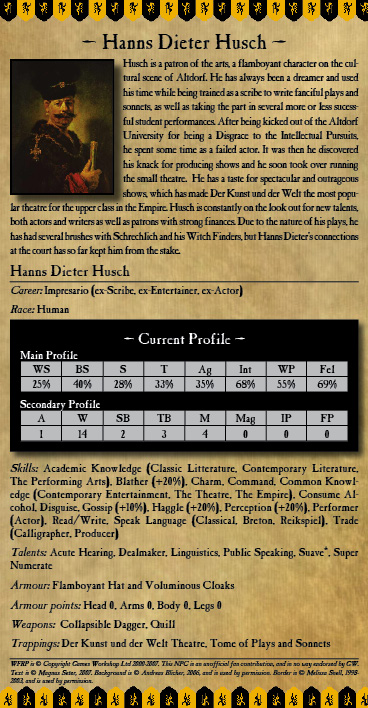
1. NPC cards. You’ve seen my NPCs, and if not check them out at once! Anyways, I make an card for every major, and sometimes minor NPC in my campaign. I have about thirty or forty now, and I give them out to the players. It’s a good way of getting them to remember who’s who, and what they do. It also makes it a lot less common for theplayers to invent humorous names when referring to my NPCs, a rather common practice not only at my table, I gather.

2. Crazy people. The people the characters interact with often have questionable sanity and strange motivations, and they perform inexplicable actions. People are people and do the most stupid things, so it feels good to include that. And it throws off the players once in while, makes things not so predictable.

3. Spectacular consequences. Whenever someone fails at anything (be they NPC or PC) I try to use flavourful descriptions of what happens and how the world reacts to this. Since people fail quite a lot in WFRP, this makes for a fun game, and has the possibility of changing the pace of the action. Instead of someone just missing with their thrown dagger, the dagger cuts off a rope which falls on a dwarf troll slayer, who then … and so on!

4. Funny voices. I don’t know what my players think … well, yes I do. But I still don’t know if it makes my game better or not. Still, it’s a load of fun!

All this is ideally juxtaposed to a fairly realistic style (very little fantasy elements apparent in the milieu) and high pace action. Otherwise it easily becomes silly, instead of deadly, frantic AND silly.

My players love it.

Well, they really hate the NPCs, but they LOVE to hate them!

Magnus
Karl and Country

Today I happened to go by the Niederhafen docks, and caught sight of a ship sailing out of Altdorf towards Marienburg and presumably farther shores. As the crew worked under the sails, they sang this little ditty that caught my fancy. Stangely enough this song was accompanied on a concert flute by a man capering about on deck, sometimes standing on one leg. An impressive feat indeed, although I’m not sure where he pilfered the flute.

The wind is on the river and the tide has turned too late,
so we’re sailing for another shore where some other ladies wait.
To throw us silken whispers: catch us by the anchor chains –
But we all laugh so politely and we sail on just the same.

For Karl and Country in the long dying day,
And it’s been this way for five long years,
since we signed our souls away.

We bring back gold and ivory; rings of diamonds; strings of pearls –
make presents to the government
so they can have their social whirl

With Karl and Country in the long dying day.
And it’s been this way for five long years
since we signed our souls away.

They build schools and they build factories
With the spoils of battles won.
And we remain their pretty sailor boys –
hold our heads up to the gun

Of Karl and Country in the long dying day.
And it’s been this way for five long years
since we signed our souls away.

To Karl and Country in the long dying day.
And it’s been this way for five long years
since we signed our souls away.

Adolphus Altdorfer
Konistag, Sommerzeit 9, 2522 IC

Since the last post gave the link to the excellent Under the Sails by Leif Ulrich Schrader, I couldn’t resist adapting Jethro Tull’s song Queen and Country to the Old World.

Well, “adapting” is a bit of a strong word. I substituted “Queen” for “Karl”, and that’s about it. It’s a great song, though. In case you’re wondering, that guy with the flute that Altdorfer took note off is the WFRP equvivalent of Ian Anderson, front man of Jethro Tull. I’ll stat him one day.

Magnus