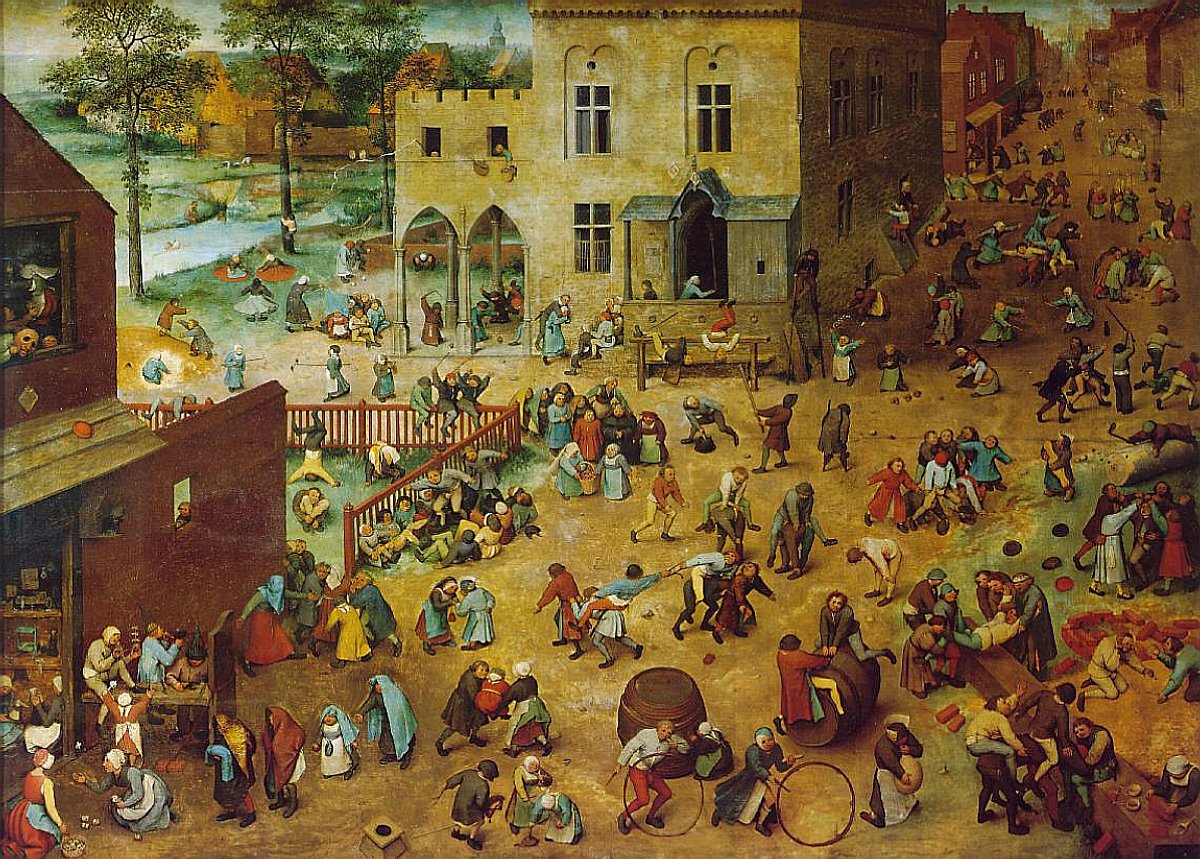
Children’s games

Pieter Bruegehl, Children's Games

It is impossible to venture out on the streets of Altdorf without being overrun by children. When I say children it is with the greatest of constraint that I chose such a benevolent word. Brats, racals, even criminals often seem a better word for them, and much better reflects their activities. Even though many children in our fair city begin working at an early age, often helping their parents out with various and sundry tasks, there are many, many who have nothing better to do than spend their time playing on the streets with their various toys.

Of these, wooden weapons seems the most common among the boys. Swords and shields are swung at unprotected heads, or indeed even at the knees of innocent passers-by, in furious battles enacting the war against Chaos. I have also observed a not insignificant group with painted tin soldiers, or troops whittled out of wood. They meet in parks and in public squares all over the city to fight out imaginary battles between the armies of the Empire and the forces of Chaos. A worrying amount of the boys involved in these different war games thoroughly enjoy playing Chaos warriors, and some even run bellowing around Altdorf, scaring women and babies, and panicking horses and cattle! A right nuisance, if you ask me!

And speaking of nuisances, the children of Altdorf seem to have made it their holy mission to remind the rest of the world of their existance; for this they use infernal rattles, pipes, bells, drums or whistles, even horns or trumpets stolen from some unfortunate coach driver add to the cacaphony of sounds of everyday life. Some foolish adults even pay children to come and scare off the ill influences of sickness and disease with their instruments of torture to the ear and sensibilities of educated people! The practice of making this noise seems to be most popular among the girls, for some reason.

Apart from the toys mentioned, the children of Altdorf play with balls made from cloth and inflated pigs’ bladders, playing games that involves much kicking and screaming. They also excel at the game called Nine Kings, where you use a ball to knock over as many of nine pins placed in varying patterns as possible in two tries. Very popular in the more affluent parts of our capital. In the poorer parts of Altdorf the children play with marbles, so called even though they are commonly made from stone or scrap glass or metal.

Adolphus Altdorfer
Bezahltag, Sigmarzeit 33, 2522 IC

While doing some quick research for this piece, I came across the painting Children’s Games by Pieter Bruegel. This paints a much better picture of what an ordinary day in Altdorf can look like, so right-click the image above and save it to disk. Then open it in an image viewer of your choice and take a closer look. It is well worth the extra effort!

Magnus

The Marble Baths

Altdorf is a grimy city, filled with waste and filth. But even so many of its inhabitants take great care to stay clean and bathe once every week. The manner in which they do so varies with social stature and income, but there is a sizeable portion that go to the public bathing houses that exist in the various Bezirks of our capital. Of course som baths are more splendid than others. Most common folk, the poor and the workers, simply use a barrel to scope cold water from, apply soap to strategic bodily locations, wash it off and rub themselves with rough towels to get dry. Not something you do every day, mind you.

For the upper class or for those of means, there are bath-houses where you get heated water in tubs or in pools. Some have rooms filled with heated rocks which you throw water on, creating steam to clean your body. Some rooms have cold pools of water so that you can alternate between hot and cool baths. There are also lounges where you can rest, eat a sausage or pie and drink a glass of wine or a flagon of cold beer.

For clients who can afford it, herbs or oils produced locally or imported from Estalia, Tilea or even Araby are added to the water to release a pleasing fragrance and promote good health and cleansing of the skin and lungs. Among the herbs commonly used are camomile, lavender, lemon balm, mint, rosemary and thyme. Oils are often scented with sap from birch or pine, or from the skins or peels from oranges, lemons, apples and pears.

Of all the bathing houses in the Empire, The Marble Baths in the Reikhoch Bezirk is probably the most well-known. The interiors are constructed from exquisite marble in Arabyan style, with beautiful mosaics depicting flowers, planets and stars. There are two sections, one for the men and one for the women. The bathers dress in simple linen trunks or dresses for the women. Curiosly both sexes often dress in something known as an Altdorf Wig, a kind of bathing hat of varying lavishness. Female bath-house keepers, often devout Shallyans in sleeveless dresses serve the bathers with buckets of hot or cold water and scrubs or lashes in the case of the more devout attendees.

Adolphus Altdorfer

Backertag, Sigmarzeit 24, 2522 IC

Sayings, words and expressions (1)

The language of the Altdorf population is colourful, and often refers to commonly known events in the capital. Some of them bewilder me, some are quite simple to understand. I have come across quite a number of these sayings and have compiled a short list of some of them, and their meanings as far as I have divined them.

“Up the Reik without a barge” – In deep trouble, often abbreviated “Up the Reik.”

“Short crowd” – A gathering of angry people with no power. They don’t pose a threat, much like a bunch of halflings wouldn’t (they would make up a short crowd, hence the expression).

“Carstein Cattle” – inhabitants of Sylvania.

“Drunk as a map-maker” – derived from the fact that many maps of the Empire often are faulty and inconsistent, hence they are probable made by drunken map-makers.

“Moose-head” – norse raider. Refers to the helmets often worn by the Norscan warriors.

“Tybalt handshake” – a weak handshake, derived from the fact that chancellor Mornan Tybalt had his thumb clipped by rioters during a riot some years ago, in protest of his proposed labour tax.

“Altdorf party” – a riot.

“He’s riding the griffon” – someone is boasting, greatly exaggerating his prowess (often “romantic” prowess or combat skills). Could also mean that a person is mad, or hallucinating. Derived from the legends about The Emperor riding a griffon.

“Mad as Alfred” – Describes a person out of his mind, insane or just very, very different. Derived from Altdorf’s most famous and loved madman, called Mad Alfred. I’ll give you more details on this fascinating person in later writings.

“There’s no such thing as a free pie” – nothing in the Old World is free, everything has its price. You’ll never get anything for nothing. Also “a deal to good to be true”.

“A private war” – someone’s own personal business. “Well, it’s his private war, there’s nothing we can do to help”.

“Airhead” or “Cloudhead” – derisive term for Wizard, implying that they have their heads stuck in the clouds and consider themselves above mere mortals. Not used when a wizard is around, I gather.

“A Bergsburg deal” – a deal or offering that is on and off, depending on the whims of the people making the offering. Refers to the disputed status of the town of Bergsburg among the Imperial cartographers.

There are many more sayings like this, and I hope to document more as I spend more time talking to the people of Altdorf.

Adolphus Altdorfer
Konistag, Sigmarzeit 18, 2522 IC

Check out this link to the Black Industries forums, where Happy Gibbon started a fantastic thread about the sayings of the people of the Empire. The above list is my contribution, and you’ll find many more from Happy Gibbon as well as other contributors.

Magnus